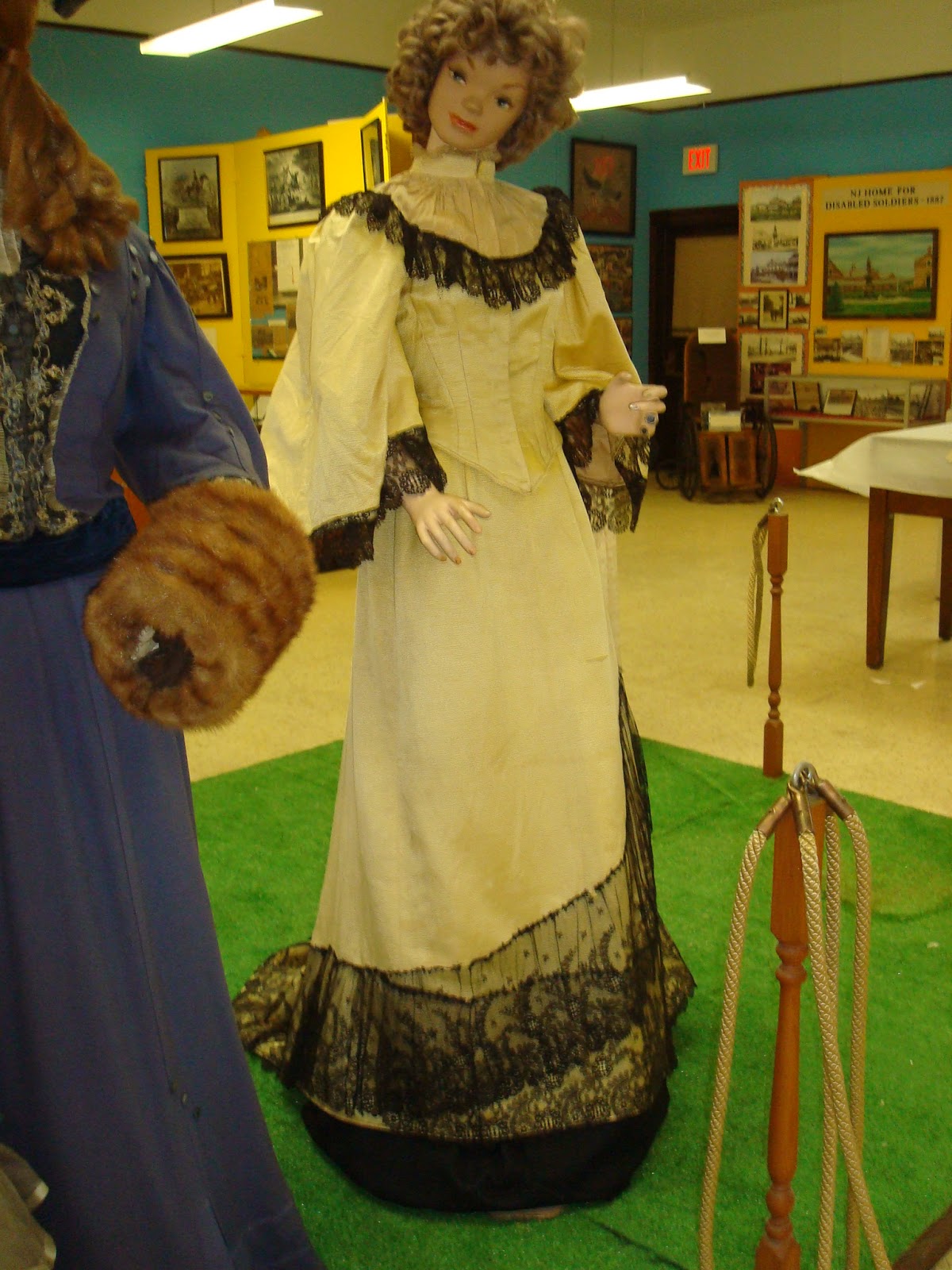
This gold corded silk gown is very interesting in terms of dating and
construction. The seamlines on the bodice indicate that it is clearly
from the 1890s (1894-7 is a more specific estimate), but the display
card and the neckline decoration are plausibly from 1903. It is likely
that this gown was refashioned to fit in with changing styles; this was a
popular practice for hundreds of years, as clothes that grew out of
fashion were either refashioned to the new style or the material was
scrapped and used for something else. Waste not, want not! Centuries of
women were recycling their mother's and grandmother's clothes before it
became the fashion norm (I'm talking to you, Etsy!).
I asked around the fashion history blogosphere for some insight on this
dress, and surprisingly, almost everyone agreed that the bodice was on
backwards! I never would have guessed until it was pointed out to me,
but now that I've noticed it, I realized that the sleeves in this
position show the center seam and there is too much fullness at the
front of the sleeve--the old museum crew really did put this bodice on
backwards!
The gown has large, full cape-like sleeves, trimmed in a matching black lace.
 |
| Large water stain on one of the sleeves. |
 |
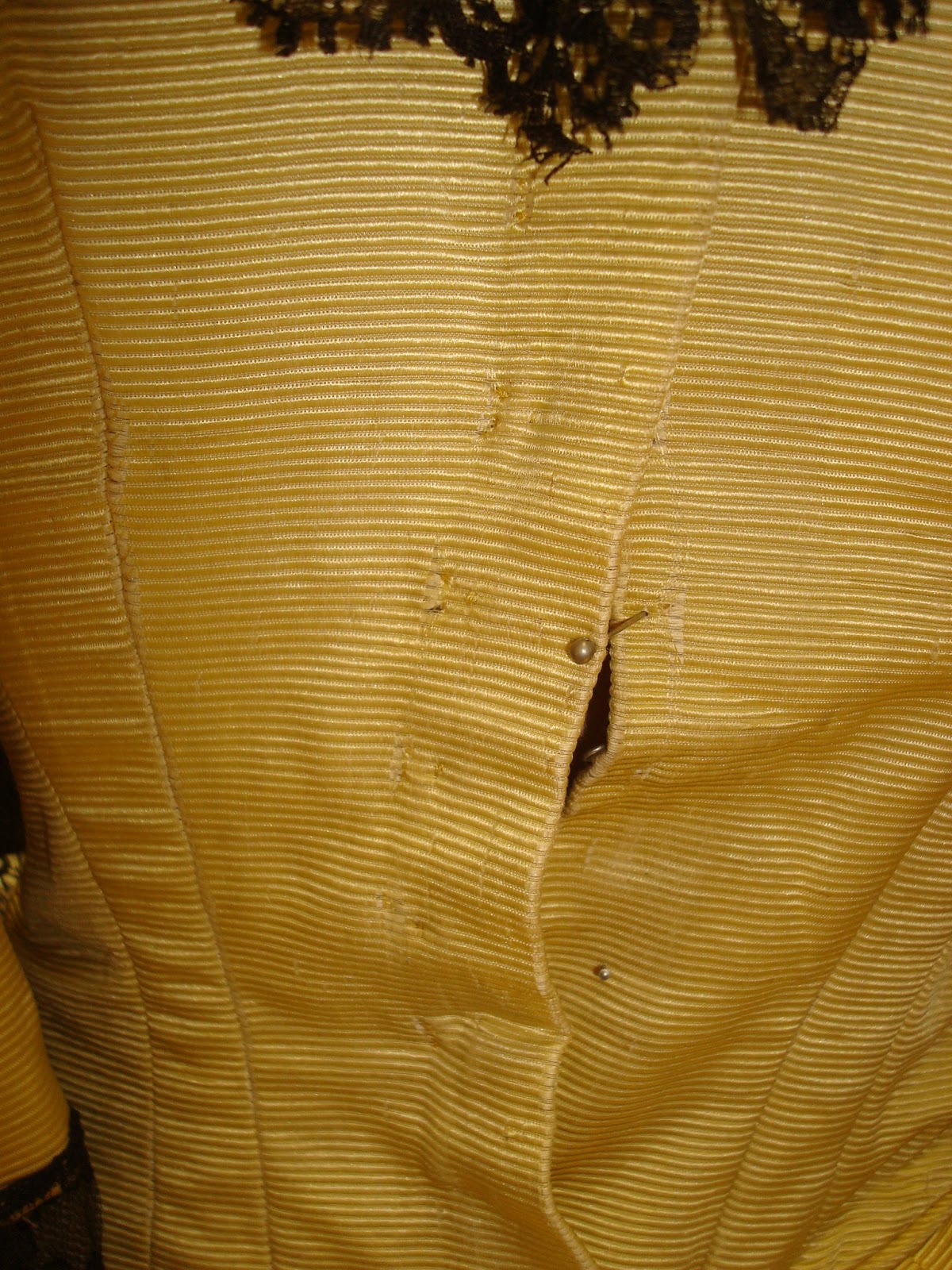
| The bodice fastens in front with hooks and eyes. About 1" of the fabric
overlaps to disguise the closure. This is the closure viewed from the
back--when the bodice was on backwards. |
 |
| Further proof that the neckline decoration was a later alteration: the
cream fabric and black lace have been merely basted in, and the edges
weren't even cut neatly or turned under. Looks like a pretty quick
fix-up. |
 |
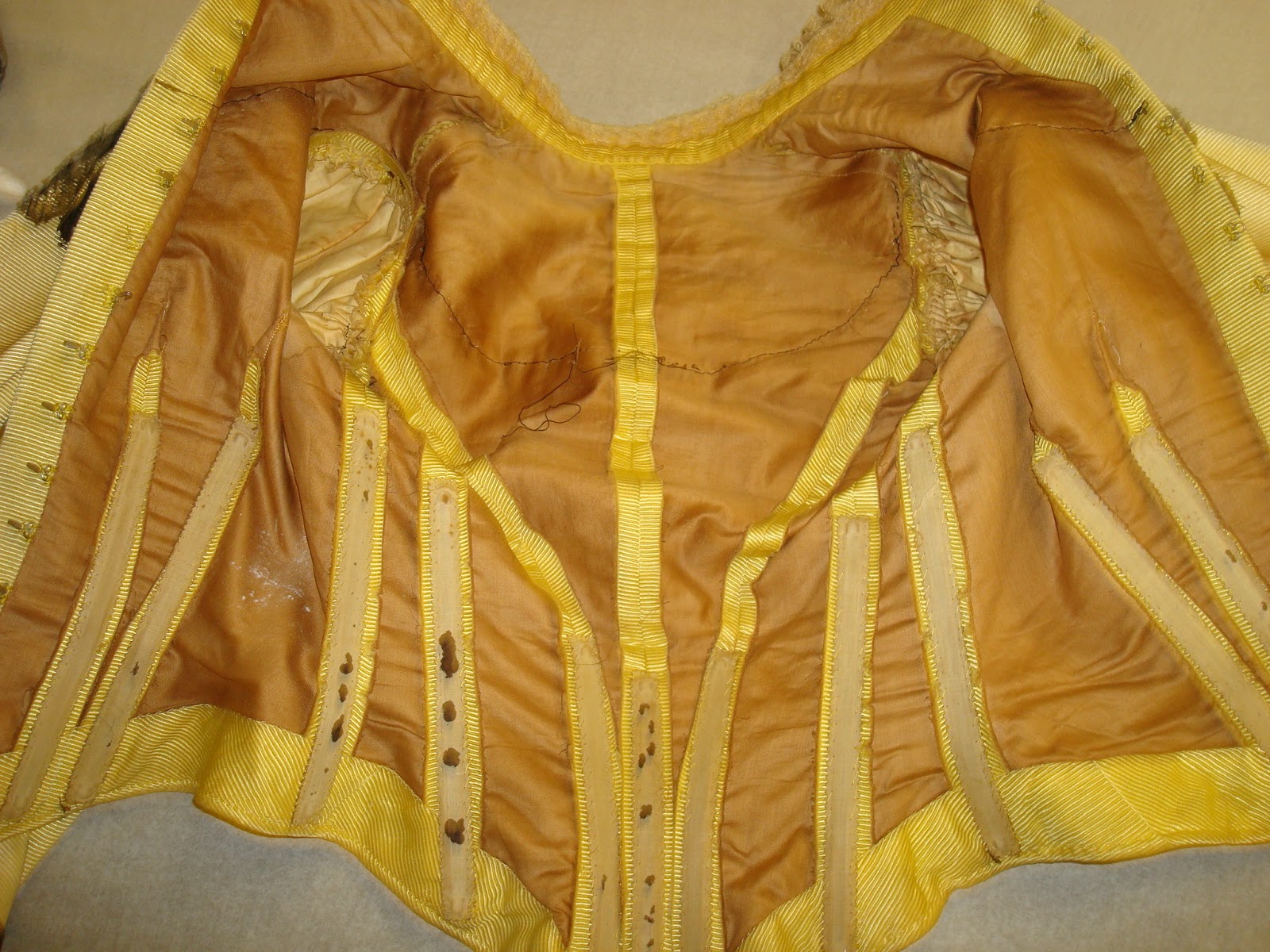
| Note the rusting on the bone casings. Bodice is lined in brown cotton. |
 |
| The armscyes have been left with raw edges and basting stitches. |
 |
| Stitches securing the c. 1903 bodice alteration. |
The skirt is pleated in the back to a cotton waistband. There is a large
triangular godet in the back of the skirt that gives the skirt fullness
and dramatic sweep. The waistband doesn't appear to have a closure;
there are no buttonholes or stitching, no evidence of hooks and eyes.
The waistband is held shut with a huge safety pin, which was tugging and
tearing the fabric (the skirt is very heavy). After removing the
bodice, the original color of the skirt is visible. Although it hasn't
suffered too much from the sun, the gold silk has lost its original
luster. The skirt is lined in yellow cotton. It is trimmed with a wide
swath of black lace that also might've been a later addition, since the
lace stops at the left thigh and the raw edge was neither cut neatly or
turned under.
The mannequin's posture is very strange; her hips lean forward and she
doesn't have much of a derriere, so the weight of the skirt pulls up the
hem in front. Whoever displayed this dressed devised an interesting
(read: ineffective and weird) support system: a dirty blue polyester
shirtdress folded up and attached to a rope cord that looped around the
mannequin's waist. This was covered with a large piece of packing paper
stapled to wide grosgrain ribbon, also tied around the waist. As you can
see from the photos, this technique did nothing to imitate the posture
and body shape of an 1890's woman and the skirt was woefully
unsupported.
 |
| The dingy shirtdress. At least wash your clothes if you're going to use
them under antique garments! (Don't use them! Use only
archival-appropriate materials when storing or displaying antique
garments!!) |
I sewed the waistband closed, to avoid further damage and pulling on the
waistband fibers from that huge safety pin. I used rolled up wads of
acid-free tissue paper to fluff up the mannequin's behind but to no
avail--her posture is so bad that the skirt has no choice but to lift up
in front. The worst part was that this showed the mannequin's rusting
pink-brown stand and feet. I tried my best to clean the crud off of the
stand, but that only chipped off more paint, revealing an even worse
color underneath. To solve this, I took a length of black felt (which I
found lurking in the back room) and arranged it under the skirt to 1.
simulate the appearance of a petticoat/ underskirt 2. not be as horribly
distracting to the overall look of the dress. I also used wads of
acid-free tissue paper to simulate the support of petticoats and fluff
out the skirt around the legs. I cleaned up the whole mannequin,
vacuumed the wig, put the bodice on the right way, and the look of the
display was already improved.
 |
|
 |
| The sleeves drape much better now. You can also see where the delicate black lace trim abruptly ends. |
 |
| The bodice looks so much better this way, but sadly the fading becomes more visible where the edges previously lapped over each other. |
 |
| I wasn't able to fasten all of the hooks since I didn't want to put too much force on the fabric. |
The dress was accessorized with a brown velvet hat topped with a bird's
head, black knit gloves and a black beaded handbag. The black gloves
were streaked with dust (or possibly fading). I soaked them gently in
water, and each soak turned the water murky brown. I wasn't able to
totally clean the gloves, but at least this is an improvement.
 |
| Before washing the gloves. |
 |
| The rope attached to the handle was tied so tightly I was unable to
remove it. It may have been to help keep the purse on the mannequin's
wrist. The purse is stuffed with a torn, delicate embroidered silk
handkerchief. |
 |
| The final look with the accessories. |