Sunday, July 6, 2014
Edwardian Petticoat with Cluny Lace
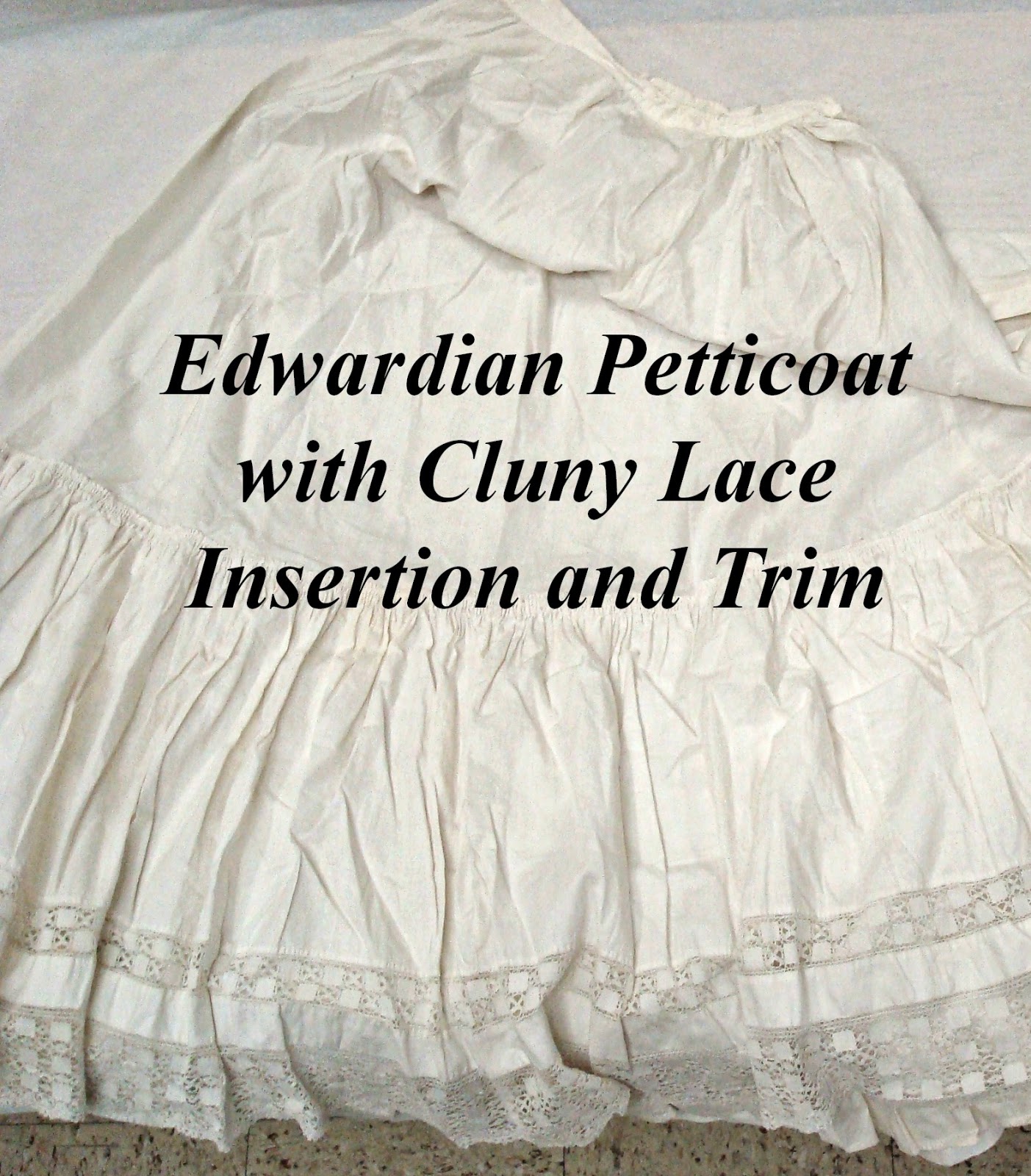
This Edwardian petticoat, c. 1900-1909, was tucked away in a box in the Kearny History Museum's storage. It has since been wrapped in layers of acid-free tissue paper and stored in an archival quality box.
This petticoat is made of a fine yet sturdy cotton, which may have originally been a truer, brighter white. Its volume is achieved through shaped panels, or gores, and a large, gathered ruffle along the bottom of the skirt. The side seams of the petticoat are constructed with the flat-felled method for strength and durability.
The petticoat has one row of fine, [presumably] cluny lace insertion, and a matching, wide band of cluny lace trim. Both the insertion and the trim appear to have been applied to the petticoat by hand.
The ruffle has three lines of gathering stitches to create fullness. The entire petticoat, except for the decoration, appears to be machine-sewn.
There is an additional, shorter ruffle on the inside of the bottom ruffle which adds even more shape to the petticoat. This ruffle appears to have been gathered with two lines of machine stitching.
I apologize if any of the pictures make the details of this garment blurry. Photographing white on white can be rather challenging! If you would like me to re-photograph specific areas of this petticoat, please don't hesitate to let me know!
The petticoat has a large tear along the back, just under the placket. I wonder if the wearer tore this while walking, or if an inconsiderate perambulator stepped on her skirts!
The back panels of the petticoat are very tightly gathered with cartridge pleats to the waistband. The waistband is narrow, and remnants of a cord/drawstring closure exist.
Measurements:
Waist: approximately 26 "
Width of Hem: approximately 95.5 "
Note: All measurements are approximate; I didn't have a table or tape measure large enough to spread the whole petticoat flat and measure it. Please feel free to let me know if you would like more detailed measurements.
Saturday, May 3, 2014
Completed 1870s Bustle
I began the bustle in September of 2012, and worked on it on and off throughout the past few months, finally finishing it in February. It is made in an unbleached muslin from Truly Victorian Petticoat with Wire Bustle 101. I made the ruffled overlay because the bustle will be used in my next mount at the Kearny History Museum: an 1870's olive green silk gown! The ruffled overlay will help support the heavy weight of the gown, of which the bodice back and skirt back are cut all in one piece.
I loved the pattern: the paper was thick and it was easy to fold back the sizes I didn't need. The bustle went together less than smoothly though...bottom line, don't tackle a new pattern with boning when exhausted!
It started going downhill with the boning. I sewed the horizontal casings to the wrong side, causing great frustration when it was time to apply the arched bone.
Then, with the ruffled overlay, I cut the ruffles all the same width...and sewed them on...then D'OH spent hours unpicking stitches. Finally I got the ruffles right, but realized that my overlay had one less layer of ruffles than it was supposed to. By that time I didn't want to take everything apart again, and left it. Then, I was possessed to unpick the waistband and sandwich the overlay between the waistband....what? For the sake of sanity, don't sew when tired! Because of silly mistakes, I used up 3 spools of thread: first white, then beige, then darker beige!
![]() |
| Side Back |
![]() |
| Side |
![]() |
| Front |
![]() |
| Back |
There is no waistband fastening as the bustle will be sewn to the dress form, preventing points of stress between the silk gown and the hook.
![]() |
| Ack! Another whicker dress form! This gown already has a dress form being carved for it. |
Wednesday, December 11, 2013
Blog Update
The About the Museum page has finally been updated!
I hope the page is an informative and entertaining read!
Monday, December 2, 2013
Museum Mysteries: Grimy Edwardian Petticoat
Interestingly, the upper folds and waistband seem to be the worst areas affected by the moisture damage, but the entire petticoat is dirty. This leads me to believe that it was left dirty before it was even displayed under the wedding gown (Hint: don't put dirty petticoats under antique gowns).
![]() |
| Eeek! |
![]() |
| The material was finely machine-pleated to a yoke. |
![]() |
| The lace trim has also torn from the seam in a few places. |
![]() |
| Submerged in water. I'm not sure what the accession number (written in marker) means. |
![]() |
| A sample of the water after I removed the petticoat from its soak. |
![]() |
| My method for drying the petticoat in a limited space: folding it up and propping it on a bookstand hooked onto the drawer pulls. Unorthodox, but it worked! |
![]() |
| The not-so cleaned petticoat...it definitely needs some soap and a larger washing vessel. Laying it flat to dry would also help! |
Tuesday, October 8, 2013
Faded Wool, Silk, and Velvet Bodice c. 1905-8
The original, awkward, extremely anachronistic display of this bodice is described here. This bodice was infested with moths, so before I was able to properly store it, I had to tuck it in the freezer for a bit to kill off the moths.
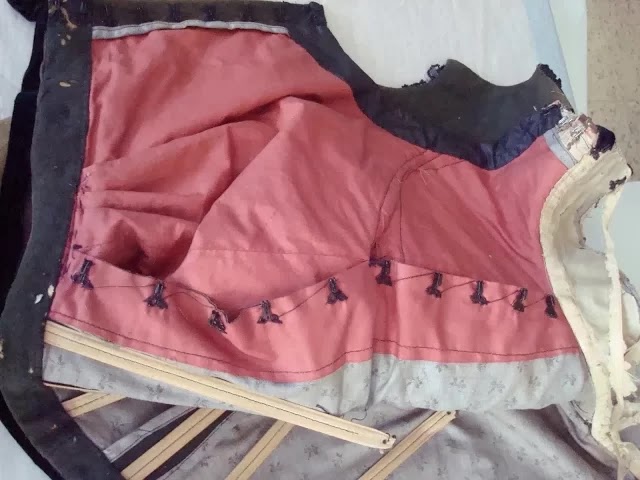
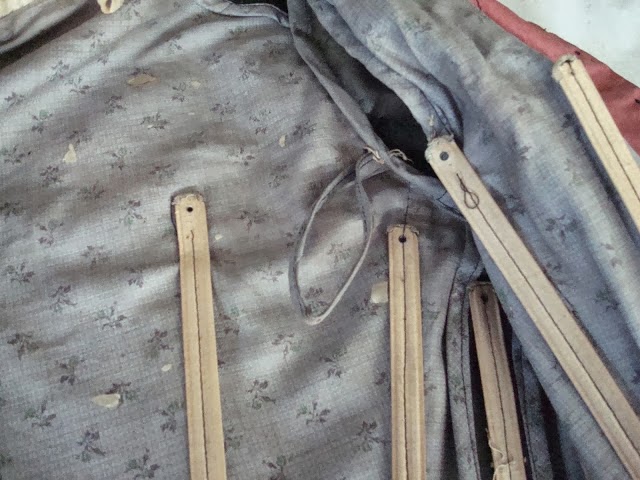
This wool bodice had faded from a dark forest green to a dull moss color. The silk inset and neckband is very shattered. The neckband is trimmed with two strips of narrow black velvet ribbon. Black velvet also trims the waistband, and ends in a decorative "bow" at the left side closure. The sleeve cuffs and bodice are decorated with black velvet cut in a sharp scallop pattern. The scallops are decorated with seed beads and sequins. The bodice is lined in coral-colored cotton, black (possibly polished) cotton, and a gray floral pattern.
![]() |
![]() |
| Fading under arm. The forest green wool faded to a soft olive shade from excessive exposure to sunlight. |
![]() |
| The original color of the wool was preserved underneath the decorated beaded velvet "flaps." |
![]() |
| The silk lining of the neckband and the silk inset had shattered. |
![]() |
| The front flap is lined in coral-colored cotton. Beige bias binding encloses the seam. |
![]() |
| Two sets of hooks and eyes in the front: on the right hand side of the "pigeon" gathers, and on the left side seam. |
![]() |
![]() |
![]() |
| Black polished cotton is replaced for the green wool where the bodice fastens and overlaps. |
![]() |
| I wonder what this loop is for? |
![]() |
| Two hooks, presumably to secure a skirt. |
![]() |
| Large stitches in black thread hold the gathers of the decorative velvet waistband in place. |
![]() |
| Pleats on the elbow of the sleeve. |
Saturday, September 21, 2013
Victorian Black Silk Lace Shawl
Just like the Edwardian Child's Lace Coat,
this black lace shawl was crumpled up inside a box. Some areas of the
shawl are discolored to strange shades of brown and olive, due to sun
exposure in the room where this was stored. The room has 3 nearly
floor-to-ceiling windows, each barely covered with a sheer plastic-y
curtain; parts of the shawl must've been too close to the opening of the
box, and thus got tinged by the sun.
The shawl definitely feels like it's made of silk. I'm guessing it's late 19th century at the earliest, since it seems far too small to be a mid 19th century shawl. The flowers are similar to this shawl whose net background is much heavier. The shawl also looks like it was machine made, due to the thickness and tightness of the flower border motif.
I didn't want to display this shawl because I didn't want to risk any further sun damage. Also, it didn't seem an appropriate accessory to any of the garments on display. I carefully wrapped it up in many layers of acid-free tissue paper and stored it in a clean box.
The shawl definitely feels like it's made of silk. I'm guessing it's late 19th century at the earliest, since it seems far too small to be a mid 19th century shawl. The flowers are similar to this shawl whose net background is much heavier. The shawl also looks like it was machine made, due to the thickness and tightness of the flower border motif.
I didn't want to display this shawl because I didn't want to risk any further sun damage. Also, it didn't seem an appropriate accessory to any of the garments on display. I carefully wrapped it up in many layers of acid-free tissue paper and stored it in a clean box.
![]() |
![]() |
| The shawl spanned the whole length of this table, almost 5 feet long! |
![]() |
| Some of the green and copper discoloration. |
![]() |
Tuesday, September 17, 2013
Edwardian Child's Lace Coat
This delicate cotton lawn and lace coat was found crumpled up at the
bottom of a box in storage. It has a few dirt (?) stains but I was wary
on cleaning them because the fabric and lace was torn in a few places
and I didn't want to aggravate the damage. I did, however, store the
coat properly by wrapping/lining it in layers of acid-free tissue paper
and then placing it in an archival-quality box. The curved breast shape
of the coat seem to indicate a pigeon-front style, and the decoration is
a strong indicator that this piece is Edwardian.
The coat has a single snap fastening at the front, though the snap seems very modern--shiny and new--to me, so it was perhaps a later alteration when the old closure (likely a hook and eye) fell off. The skirt of the coat is slightly flared. The size and styling suggest that this may have been worn by a girl about nine years old.
The lace insertion all over the coat is a testament to the patience of the seamstress who made this: white cotton picot trim is connected by a white cotton tape woven through the picots! This treatment is used decoratively (as on the sleeves) and structurally (as on the armscye seam). The picot trim and insertion was sewn by machine. However, I'm unsure if the lace embroidery on the chest and back was down by machine or by hand--though I think it was likely machine made.
The coat has a single snap fastening at the front, though the snap seems very modern--shiny and new--to me, so it was perhaps a later alteration when the old closure (likely a hook and eye) fell off. The skirt of the coat is slightly flared. The size and styling suggest that this may have been worn by a girl about nine years old.
The lace insertion all over the coat is a testament to the patience of the seamstress who made this: white cotton picot trim is connected by a white cotton tape woven through the picots! This treatment is used decoratively (as on the sleeves) and structurally (as on the armscye seam). The picot trim and insertion was sewn by machine. However, I'm unsure if the lace embroidery on the chest and back was down by machine or by hand--though I think it was likely machine made.
![]() |
| The front of the coat. |
![]() |
| All of the delicate picot seams, and that nasty brown stain from this garment being crumpled up in a box! |
![]() |
| The delicate sleeve trim. |
![]() |
![]() |
| With the coat open. Look at that curve! |
![]() |
| (Sorry for the blurry photo!) A very modern-looking snap. |
![]() |
| The back of the coat. |
Subscribe to:
Posts (Atom)