Saturday, September 7, 2013

1894-7 Corded Silk Gown with Later Alteration


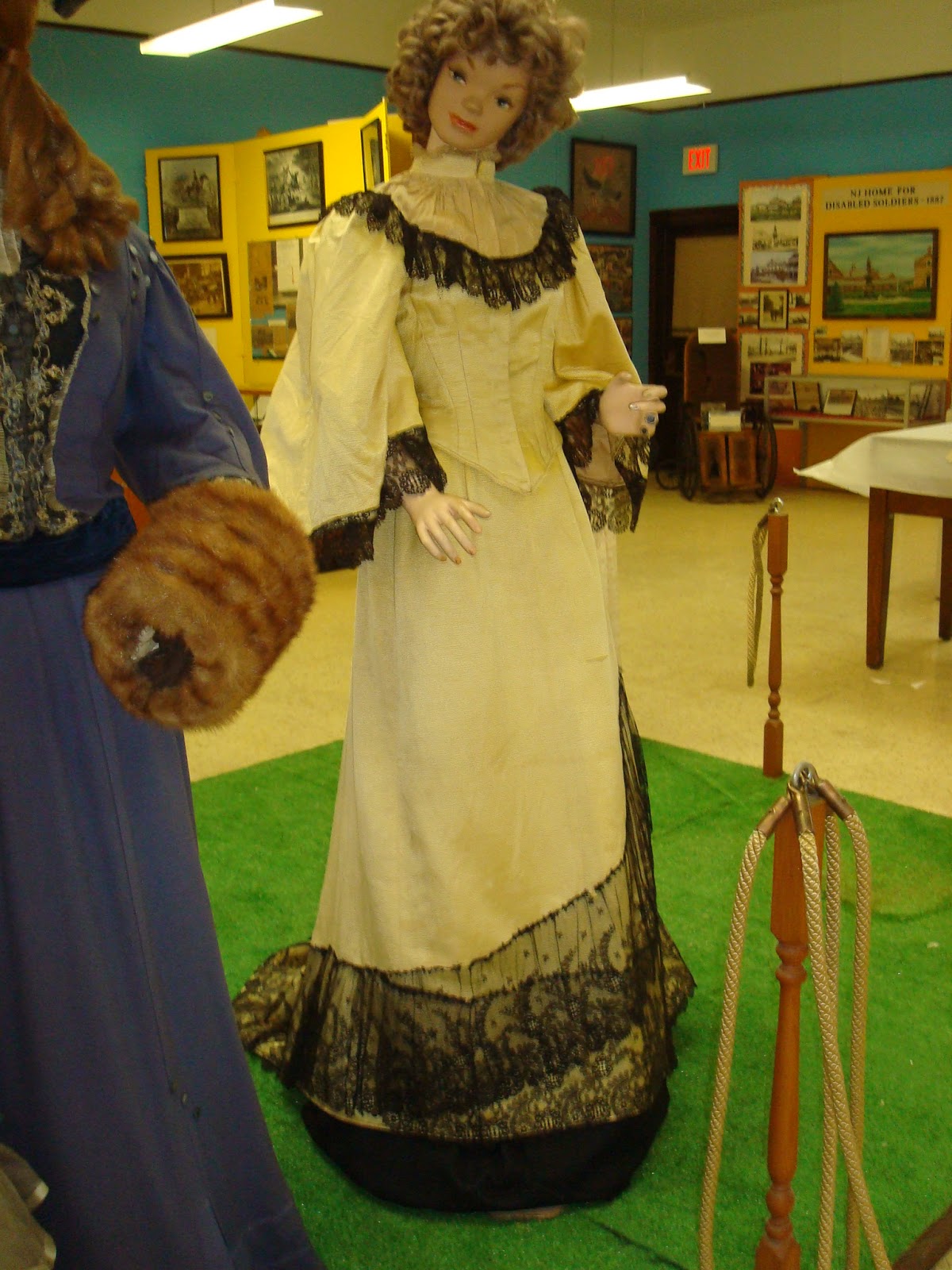
This gold corded silk gown  is very interesting in terms of dating and construction. The seamlines on the bodice indicate that it is clearly from the 1890s (1894-7 is a more specific estimate), but the display card and the neckline decoration are plausibly from 1903. It is likely that this gown was refashioned to fit in with changing styles; this was a popular practice for hundreds of years, as clothes that grew out of fashion were either refashioned to the new style or the material was scrapped and used for something else. Waste not, want not! Centuries of women were recycling their mother's and grandmother's clothes before it became the fashion norm (I'm talking to you, Etsy!).

I asked around the fashion history blogosphere for some insight on this dress, and surprisingly, almost everyone agreed that the bodice was on backwards! I never would have guessed until it was pointed out to me, but now that I've noticed it, I realized that the sleeves in this position show the center seam and there is too much fullness at the front of the sleeve--the old museum crew really did put this bodice on backwards!

The gown has large, full cape-like sleeves, trimmed in a matching black lace. 


Large water stain on one of the sleeves.

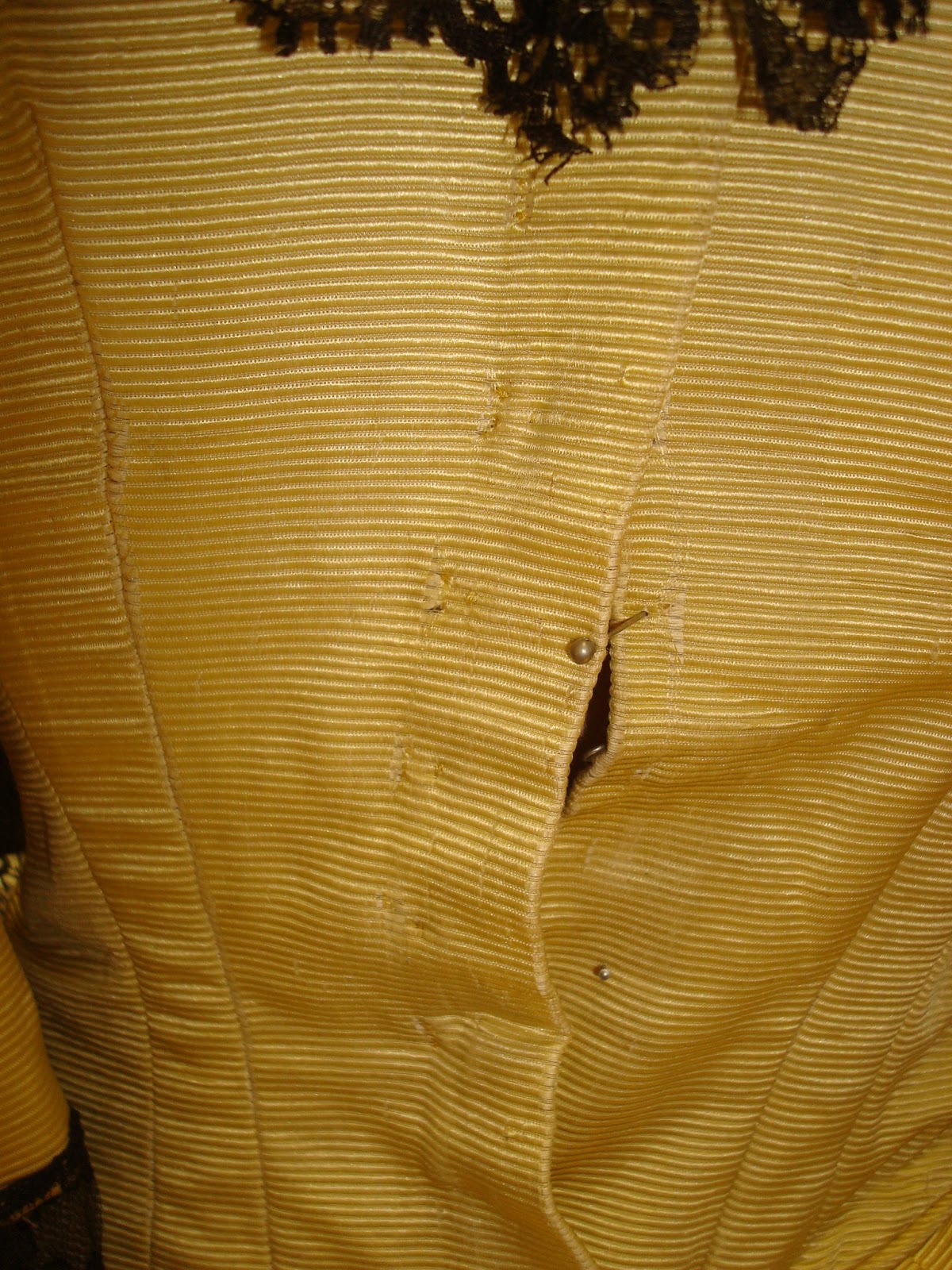
The bodice fastens in front with hooks and eyes. About 1" of the fabric overlaps to disguise the closure. This is the closure viewed from the back--when the bodice was on backwards.
Further proof that the neckline decoration was a later alteration: the cream fabric and black lace have been merely basted in, and the edges weren't even cut neatly or turned under. Looks like a pretty quick fix-up.
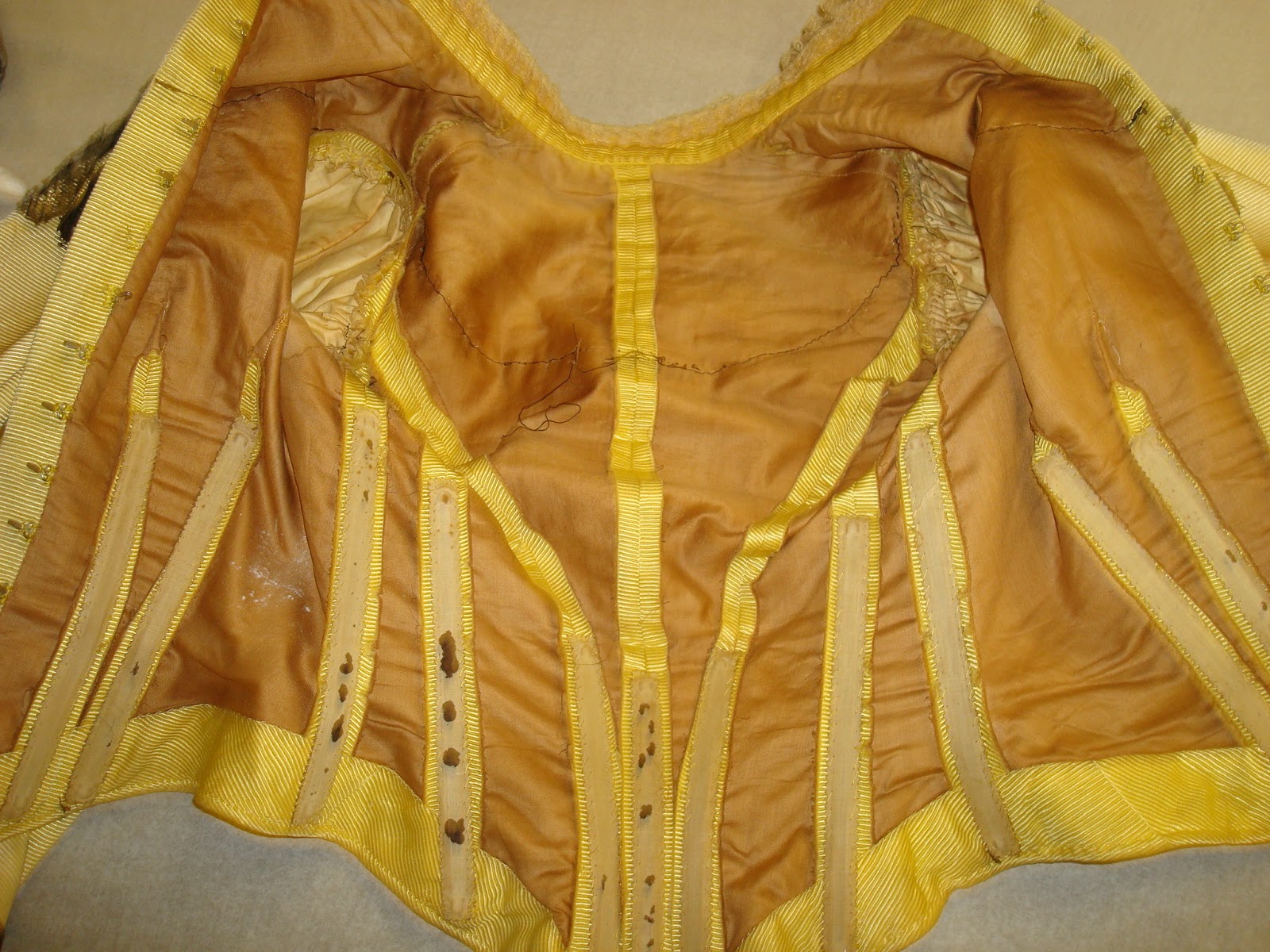
Note the rusting on the bone casings. Bodice is lined in brown cotton.

The armscyes have been left with raw edges and basting stitches.
Stitches securing the c. 1903 bodice alteration.

The skirt is pleated in the back to a cotton waistband. There is a large triangular godet in the back of the skirt that gives the skirt fullness and dramatic sweep. The waistband doesn't appear to have a closure; there are no buttonholes or stitching, no evidence of hooks and eyes. The waistband is held shut with a huge safety pin, which was tugging and tearing the fabric (the skirt is very heavy). After removing the bodice, the original color of the skirt is visible. Although it hasn't suffered too much from the sun, the gold silk has lost its original luster. The skirt is lined in yellow cotton. It is trimmed with a wide swath of black lace that also might've been a later addition, since the lace stops at the left thigh and the raw edge was neither cut neatly or turned under.

The mannequin's posture is very strange; her hips lean forward and she doesn't have much of a derriere, so the weight of the skirt pulls up the hem in front. Whoever displayed this dressed devised an interesting (read: ineffective and weird) support system: a dirty blue polyester shirtdress folded up and attached to a rope cord that looped around the mannequin's waist. This was covered with a large piece of packing paper stapled to wide grosgrain ribbon, also tied around the waist. As you can see from the photos, this technique did nothing to imitate the posture and body shape of an 1890's woman and the skirt was woefully unsupported.


The dingy shirtdress. At least wash your clothes if you're going to use them under antique garments! (Don't use them! Use only archival-appropriate materials when storing or displaying antique garments!!)
I sewed the waistband closed, to avoid further damage and pulling on the waistband fibers from that huge safety pin. I used rolled up wads of acid-free tissue paper to fluff up the mannequin's behind but to no avail--her posture is so bad that the skirt has no choice but to lift up in front. The worst part was that this showed the mannequin's rusting pink-brown stand and feet. I tried my best to clean the crud off of the stand, but that only chipped off more paint, revealing an even worse color underneath. To solve this, I took a length of black felt (which I found lurking in the back room) and arranged it under the skirt to 1. simulate the appearance of a petticoat/ underskirt 2. not be as horribly distracting to the overall look of the dress. I also used wads of acid-free tissue paper to simulate the support of petticoats and fluff out the skirt around the legs. I cleaned up the whole mannequin, vacuumed the wig, put the bodice on the right way, and the look of the display was already improved.


The sleeves drape much better now. You can also see where the delicate black lace trim abruptly ends.

The bodice looks so much better this way, but sadly the fading becomes more visible where the edges previously lapped over each other.
I wasn't able to fasten all of the hooks since I didn't want to put too much force on the fabric.
The dress was accessorized with a brown velvet hat topped with a bird's head, black knit gloves and a black beaded handbag. The black gloves were streaked with dust (or possibly fading). I soaked them gently in water, and each soak turned the water murky brown. I wasn't able to totally clean the gloves, but at least this is an improvement.


Before washing the gloves.
The rope attached to the handle was tied so tightly I was unable to remove it. It may have been to help keep the purse on the mannequin's wrist. The purse is stuffed with a torn, delicate embroidered silk handkerchief.
The final look with the accessories.


Tuesday, September 3, 2013

Why You Shouldn't Display Antique Textiles Underneath A Huge Skylight

Part of my unrest from viewing the Kearny History Museum's permanent fashion exhibit the first time around stemmed from the fact that the dais on which the garments are displayed is stationed right beneath a skylight of the same size. Although this seemed like a reckless choice to me, I do understand that with the "flow" and layout of the museum, the exhibit makes spatial sense to be placed there. However, this skylight could have had its windows painted in, as other equally-monstrous skylights in the library had been. And, it also doesn't help that the whole museum is surrounded by tall windows, only half of which are covered with blinds.

Can skylights get any bigger than this!?
Light damage can be incredibly invasive, though if you aren't aware of it and don't look for it, you might not notice that it has occurred. That is, you might have to look between the pleats or folds of a skirt to see the contrast in color. However, light damage isn't always so subtle...

Take this display of an 1860's crinoline, c. 1905 wool bodice, and possibly mid-20th century petticoat (firstly, not only is this arrangement extremely anachronistic, it was also awkward due to a piece of fabric wrapped around the crinoline but left open in back to display the crinoline...). The mid-20th century petticoat beneath, originally a bright coral, had faded to milky white where the striped fabric "skirt" exposed the crinoline.

So much going on in one photo: the plastic "grass" of the display, the cage crinoline, the faded mid-20th century petticoat, the striped decorator upholstery fabric camouflaging as a skirt...


That streak of brown is actually dirt. The same dirt particles were found on the plastic bag covering the dress form.
Light damage can also be virtually invisible to the eye until we take a closer look. This c. 1905 black velvet and black wool bodice is an interesting example; the black wool has faded to a dull olive green, and I only realized that the original color was black when I read the description card. Unfortunately, I don't have a picture good enough to show this (but I will soon!). Light damage isn't only harmful to a garment's color--exposure to light can actually weaken fibers, and this may be the reason behind the silk shattering both on the delicate silk lining of the bodice and on the decorative silk piece that covers the décolletage.

To cover up some of the silk shattering on the collar of this bodice, someone had wrapped a piece of wide black velvet ribbon around the collar and decorated with a brooch. When I removed the ribbon, I realized the full extent of the damage on this small subject; where the ribbon had overlapped, it retained it's original color, but where it was exposed to the sun, it had faded to a dull, dirty brown.


Thursday, August 29, 2013

1890's Infant's Caped Wool Coat and 1860's Blue Lace Baby Bonnet


This adorable wool caped coat was displayed on a hanger dangling precariously from the 1850's Wicker Baby Carriage. It was one of several baby garments hanging off of the carriage, and sadly, this hid the beautiful wicker curlicues from view. By removing that ugly baby "doll" from the carriage, I was able to display the various infant garments inside the carriage.

This A-line coat fastens with just a large hook and eye at the neck. The body of the coat is lined in ivory linen, while the cape is lined in ivory satin. The waist and sleeves are decorated with little cartridge pleats. The fullness at the back of the coat is controlled with two knife pleats. The coat has a weird, small, gathered attached cap-like piece, however, whose function I'm unsure of. Was this to protect the back of baby's head when baby was lying in the crook of an arm? Or was this meant to flap back onto the cape? It really is so small, and placed weirdly, so that it would be almost impossible to squeeze an infant's head in there.


Lining of the body of the coat.

Museum accession number--I think...
The mysterious, gathered floppy cap-like piece at the neck of the cape.
Back of the coat.

This blue floral lace baby bonnet was a gift of Mrs. Magenheimer, who has donated several objects to the museum. This bonnet was displayed on a yellow Styrofoam head with a yellow giftwrap ribbon bow around the neck, a distracting and rather "cheesy" setup. It is now displayed inside the1850's Wicker Baby Carriage, along with the coat.

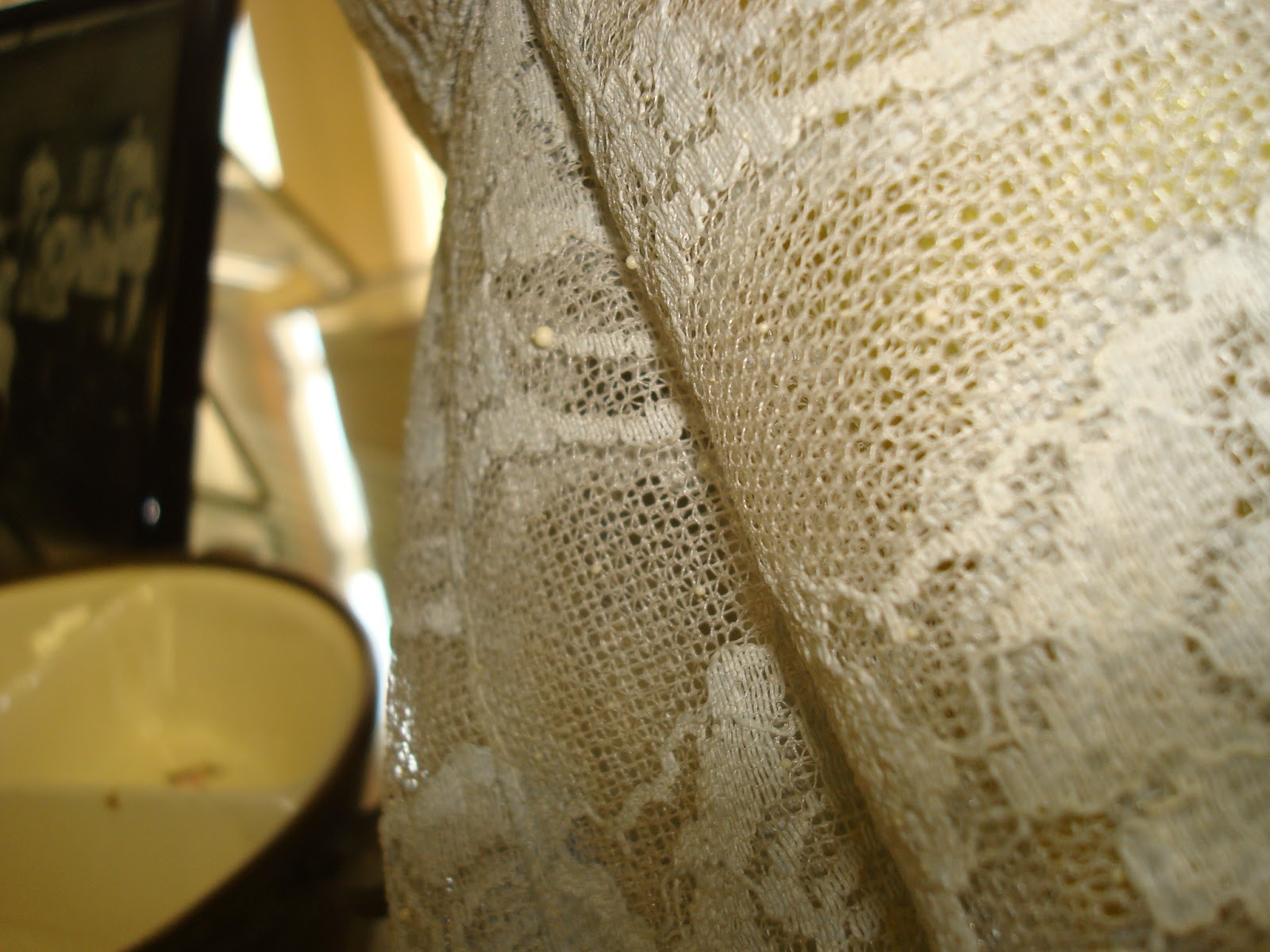
The pleats, held with starch, were made with a double layer of the lace. Frankly, the whole bonnet seems rather large for a baby's head, as it was just a bit too small for the Styrofoam head mount. The crown of the bonnet had some dirt and grit on the surface. The whole bonnet was sprinkled with teeny yellow spheres that I originally thought were sacs of insect eggs, but that I later realized (with some help from the circulation desk) were actually paint splatters!!! The yellow paint must've been from those yellow wooden dividers around the room...how could the person painting them have been as careless as to splatter paint onto the museum's precious objects?! I did my best to wash the bonnet, soaking it several times in cold water (and I found an insect that had been eating the starch!!) but the paint splatters still remain...

Part of me has a really hard time believing that this blue lace bonnet is from the 1860's. The fabric just seems so stiff and synthetic to me, and the pattern of the lace itself is large and clumsy, lacking the gracefully intricate designs of even machine-made laces of the era. The lace is obviously machine made, but the fiber content is difficult to determine. The lace is neither silk, linen, nor wool; all plausible options for the mid 19th century. The bonnet, although starched, has a distinctly scratchy feel. The background net is a hexagonal shape.


Detail of the two layers of the lace in the pleats, and some of the splattered paint domes.
Many more little paint domes...
Lots of dirt and grit on the crown of the bonnet.
The coat and the bonnet are now displayed inside the carriage, along with a pintucked Christening gown and a lace Christening gown. This really allows the woodwork of the carriage to "pop" against the soft shades of white and ivory. The carriage was originally placed in the far corner of the dias, but now it is more incorporated into the display by being alongside the matronly 1907-09 Blue Wool Visiting Dress, adding to the vignette-like quality the museum committee wanted me to achieve.

The final display, with the carriage placed next to the 1907-09 Blue Wool Visiting Dress. Bonnet not visible from this angle.


Tuesday, August 20, 2013

1909-14 Silk Wedding Gown


Although donated by the same family that gave the 1870s green silk bustle gown to the Kearny Museum, this 1909-14 silk and lace wedding gown was improperly mislabeled as being part of the bride's trousseau in 1870. This wedding dress is as far from the 1870s as you could get...elbow length pleated sleeves, lace insets, pearl and rhinestone decoration, a slim, straight skirt with a slight train and a drapey swag of fabric. These elements coordinate with dresses from 1909-14.

Not only was this dress on the worst mannequin in the whole exhibit (the most crackly skin and weirdly hunched pose), the dress had suffered some kind of weird moisture damage, which left enormous, stiff stains and discoloration along the back of the dress, and mold on some of the lace.

To fit the mannequin, someone had sliced up each glove (a delicate beaded cotton style) and then taped it shut. And look just how dirty those gloves were! They were covered in murky brown stains.
The horror that awaited underneath the gloves.
The pitifully messy and discordant "bouquet" was distracting from the elegant style lines of the gown.
Beautiful sleeves, and beautiful bead and pearl trim!  Utterly scrumptious, but barely noticeable under that enormous piece of synthetic lace cloth that was draped to simulate the appearance of a veil.
The lace "veil" was the first warning sign of unimaginable grime and moisture damage.
The back of the gown. The awkward fit of the gown on a weirdly posed mannequin, combined with massive, dense moisture stains. This moisture most likely came from the enormous skylight overhead.
Mold on the fragile lace and silk.
Even more mold stains on the back of the skirt.
Where the silk had absorbed the moisture, it had dried up and become brittle to the touch, so much so that the fibers just snapped when I touched them to examine the damage.
The long folds of the ivory silk skirt couldn't escape from being permeated--and damaged--by this intense moisture.
The silk experienced some stress and consequently ripped after the thread holding the hem had rotted.
The biggest surprises in this "dress resurrection" were what I found when I removed the dress from the mannequin. The mannequin itself was nightmarishly horrifying; rather than an actual midsection, it had this weird concave midsection made of a mesh material that had also soaked up its fair share of whatever leaked through the skylight. The mannequin also wore a short Edwardian petticoat, which was terribly stained from--you guessed it--moisture damage. The silk lining of the dress fared the worst in terms of damage; it was completely shattered, with only a few threads holding down bones, hooks, and eyes.

Warning: The following images may not be suitable for children or those who are faint of heart.
GAHHH!! What is that?!?
All that water must've had soot or something in it, because the mannequin's neck--and the lace neck inset--were covered in this sooty grime.
The heartbreaking remnants of the silk lining.


This poor petticoat is in desperate need of a wash.
The wedding gown is constructed in one piece. It fastens along the left-hand side with hooks and eyes, as dresses of this period usually do. It fastens with more hooks and eyes around the front of the armscye, along the shoulder, and up the high lace collar. The lace collar still has it's original stays, though they were attached with tape. The decorative silk swag is attached at the left, swings across the waist, and is fastened at the right side seam. I couldn't get many photos of the inside because I wanted to handle this dress as little as possible.

The shoulder hook-and-eye closure.
The hook-and-eye closure along the lace collar.
The closure of the swag. And lovely decorative chainstitching!!
I decided that the best upgrade I could give it at the moment was to put it on one of those more modern mannequins, of which now I had a few naked ones lying around. This display is still by now means perfect (really due to the mannequin's awkward pose) but it still succeeds in highlighting the actual dress, instead of swamping it in layers of synthetic, dirty lace fabric and questionable styling choices.

However inaccurate the red hair is, it still helps this rather "ecru" side of the exhibit "pop."
The lovely decorative swag, in full view! The subtle train is supported by some pieces of balled-up acid-free tissue paper.
Those gorgeous sleeves are no longer smothered by that dingy lace tablecloth.

I used the veil from the 1926 Wedding Gown display to help conceal the stains on the back of the dress. I plan to replace the flower crown with a decent-looking tiara from Ebay.